Assessment
Marks a teacher can enter, and an average that is never stale.
Each average, each weighting and each “who has not been marked yet” is worked out at the moment it is read. Nothing is cached, so nothing quietly disagrees with the marks underneath it.
At a glance
Kestrel’s assessment module is a markbook, report templates and the NESA and VASS board submissions, all worked from the same marks.
A markbook that derives
Averages worked out on each read, overrides keeping their reason, formative kept apart from summative.
Dispensations applied
An approved illness, misadventure or appeal claim changes each average it touches.
Release set on the task
Each task names when its marks reach the student and the family.
Reports and board submissions
Report templates and the NESA and VASS submissions, all from the same marks.
Questions schools ask
How does Kestrel handle illness and misadventure?
An approved illness, misadventure or appeal claim writes the dispensation the school granted, and each average is then taken under it.
When do families see marks?
Each task names when its marks reach the student and the family, so release is set on the task itself.
Which board submissions does Kestrel produce?
The NESA submission, and the Victorian VASS submission from the same generator.
Show the detailHide the detail
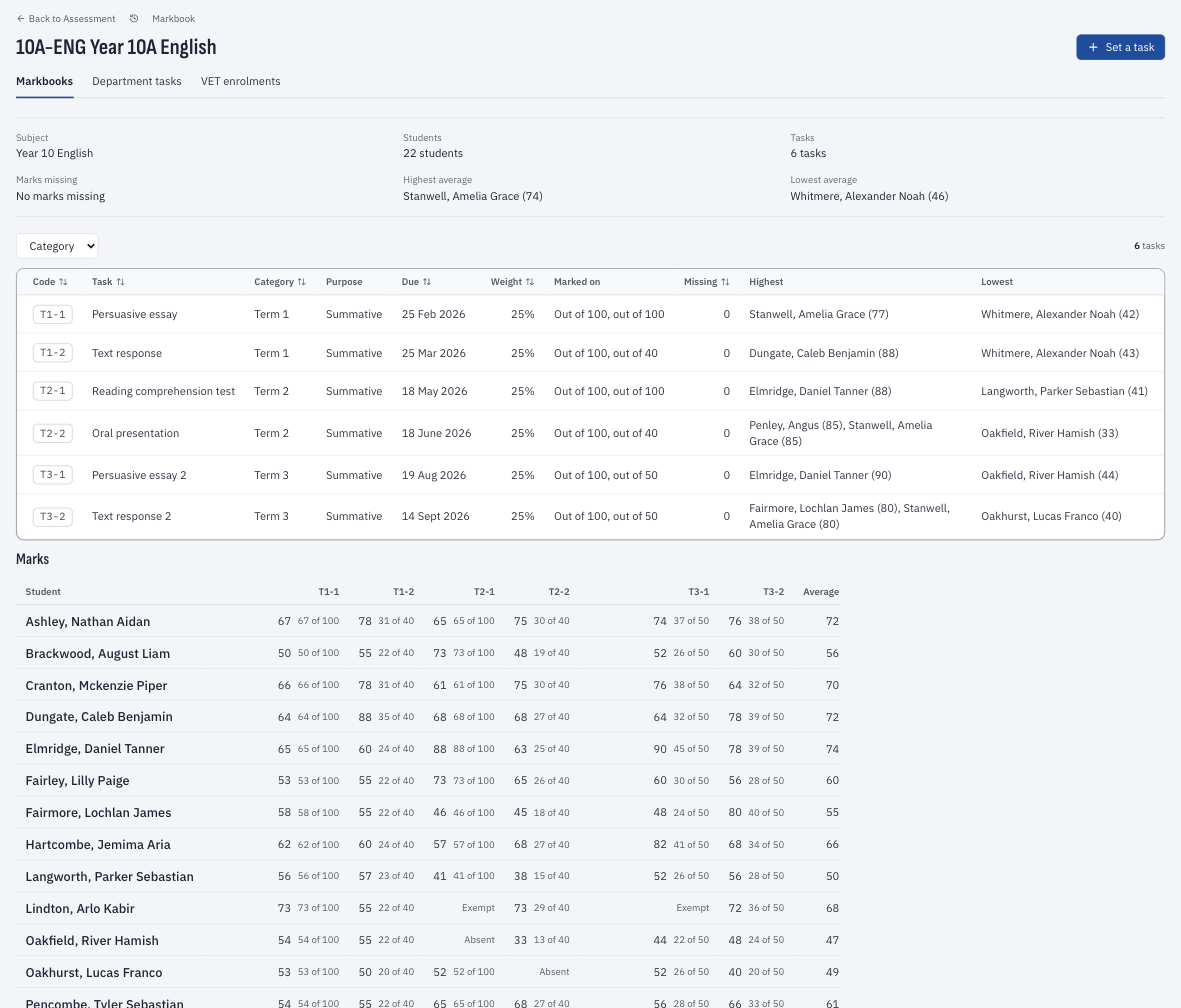
The markbook.
A teacher sets tasks for a class: each with a code unique in that class, a due date, a weight, a scale, and a mark of formative or summative. A whole column of marks is typed and saved in one action.
Illness, misadventure and appeal.
An approved illness, misadventure or appeal claim writes the dispensation the school granted, and each average is then taken under it.
The consequence matters more than the feature: a student who missed an assessment for a reason the school accepted does not get a zero on a report because somebody was away the week the paperwork came in.
When a mark reaches a family.
A task names when its marks reach the student and the family. Release is set on the task itself, so no-one has to remember to run a bulk action. A mark cannot arrive in a portal at four on a Friday because a checkbox was set on the wrong screen.
On a student’s record, the Assessment section reads their tasks for the period, with each class’s formative tasks kept apart from its summative and an average over each group. Beneath that is their own average for each reporting period of the last two years, overall or by subject or by class.
Where an overall average has fallen by more than the figure the school sets, the record shows the drop. The school chooses the figure; Kestrel does not decide what counts as a drop worth noticing.
Trends, and the students behind them.
Trends, and the students below the school’s threshold, are published for the dashboards and for the overnight read, and stored nowhere. The night reads the marks as they are, so a cohort chart and the markbook it came from cannot drift apart between one term and the next.
Reports, and results from outside.
The board submission, from the same marks.
The NESA submission writes one record per student per course: board number, year of schooling, course code and unit, and the school assessment mark the markbook derives. The Victorian VASS submission is the same generator run against the same mappings, one record per student per study and unit, with the student’s VSN.
It refuses. A class that sets a task counting toward the board but is mapped to no course is named by its code. A student with no board number stops the file. So does a board-reportable task no-one has marked.
So each student in a submission is accounted for before it leaves.
Built to be used on the day.
The markbooks open on this year’s classes. The class list fits a phone without scrolling sideways, because a roll call and a mark both happen standing up. A person holding no assessment capability is told plainly what was refused.
Bring a reporting cycle that went wrong.
Start with the eight-minute film. Then, if you’d like, forty minutes with us on your scales and your board deadline.