The statutory returns
Regulatory returns are a reading of the record, not a project.
Kestrel produces the census, the Address Collection the government uses to estimate capacity to contribute, STATS attendance and the NCCD counts, from the record you have been keeping all year. Each stays defensible eighteen months later when somebody asks where a number came from.
At a glance
Kestrel produces the non-government schools census, the Address Collection, STATS attendance and NCCD from the student record, with the evidence behind each figure.
Runs against a moment
Census, NCCD, Address Collection and STATS read the record as at a moment.
Gaps named, by student
A missing value stops the run and names the student and the field.
The substantiation pack
The rows behind each person’s figures, as a PDF, for post-enumeration and audit.
Seven years of runs
Each run kept, and asked for one collection year at a time.
Questions schools ask
Which returns does Kestrel produce?
The census with NCCD in the same file, the Address Collection, and STATS attendance, as SchoolsHUB files.
How does Kestrel help with post-enumeration?
Each run can produce a substantiation pack: the run record, the file’s checksum and, for each person, the rows behind their figures, as a PDF.
What happens when data is missing?
The run stops and names the student and the field, so the gap is fixed before the file is produced.
Show the detailHide the detail
A return is a run against a moment.
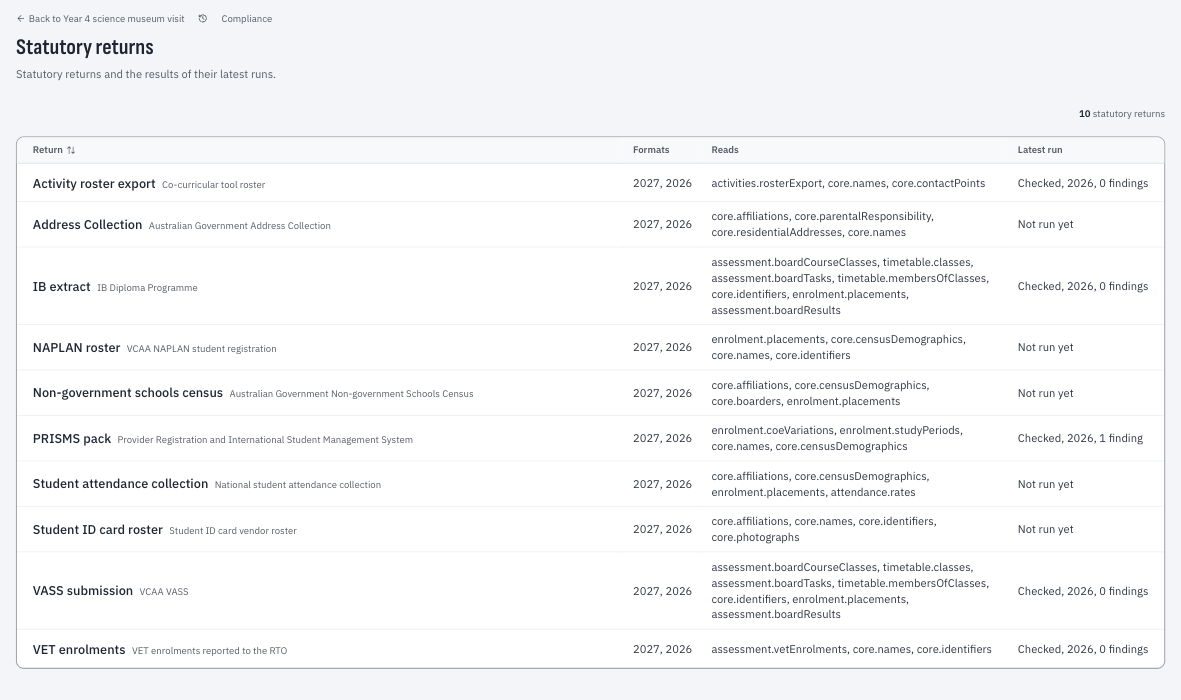
Each return declares which parts of the record it reads. Kestrel checks the record as at a moment, records what is missing by student and by field, and only then produces the file, with its checksum recorded on the run.
It stops and names what is missing.
Where the record cannot answer, the run stops and names the student and the field.
The substantiation pack.
This is the part that matters eighteen months later. Each run can produce a pack containing the run record, the file’s checksum and, for each person the run reported on, the rows behind their cells, written as a PDF an auditor can be handed.
The rows are read again, through the same parts of the record, as at that run’s own snapshot moment. Nothing was copied when the run was made, so a correction dated after the snapshot is correctly absent from the pack. The evidence is reconstructed as the record stood when the return was made.
That distinction is the whole difference between substantiation and a report. A school that exports today’s data to explain last year’s figure is producing a different number, and hoping no-one checks. An adjustment’s evidence pointers resolve to the student the adjustment was for, so an NCCD audit can follow the trail.
Producing a pack requires the passkey again, and the action is audited with the count of people it covers. Assembling each reportable fact about several hundred children into one PDF is exactly the action that should leave a mark.
Seven years of runs.
A return checked each week leaves hundreds of runs behind it over the years a school has to keep them, so the history is asked for one collection year at a time.
Producing a file also requires the passkey, and the file’s checksum is recorded on the run. So the question “is this the file we actually submitted?” has an answer that does not depend on somebody’s filing.
Where the STATS attendance rate comes from · The NESA and VASS submissions
Bring last year’s census.
Start with the eight-minute film. Then, if you’d like, forty minutes with us on your hardest figure, and where it came from.