Attendance

Who was here, who was not, and who has not been asked.

Attendance is the part of a student record that has to be right by nine in the morning and defensible when the regulatory returns are due. This page is what Kestrel does with it today, screen by screen.

At a glance

Kestrel’s attendance module takes per-lesson rolls from the live timetable, applies the NSW or Victorian code set and follows up unexplained absence the same day.

Rolls from the live timetable

A room change or a relief teacher is already on the roll the teacher opens.

The unmarked roll, chased

The lesson’s teachers are told minutes after the period, then whoever the school names.

Unexplained, resolved

One list of unexplained absences each morning, with parents explaining a day from the portal.

A front desk and a kiosk

Late arrivals, early departures and visitors recorded, and shown beside the teacher’s mark.
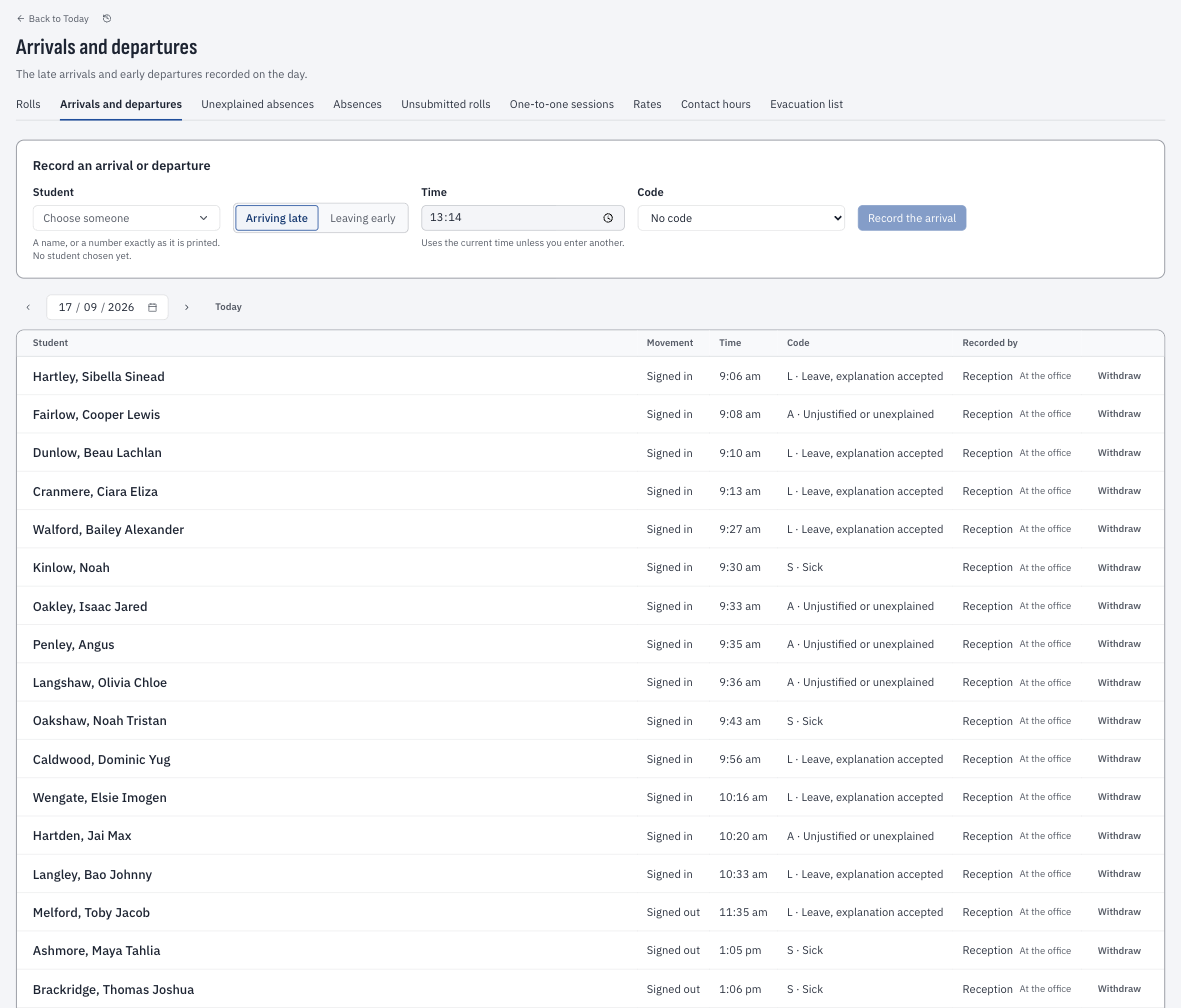
The day’s arrivals and departures: the form to record a late arrival or early departure with its time and code, then each student signed in or out, the code and who recorded it at the office.
Every arrival and departure, recorded once. Invented data

Questions schools ask

How are unmarked rolls followed up?

A job runs every five minutes. It tells the lesson’s teachers a set number of minutes after the period, then whoever holds the role the school named, by email.

How is the attendance rate calculated?

Kestrel derives it each time it is read, folding the marks, movements and bell times under ACARA’s two-hour rule.

Does Kestrel produce the STATS attendance return?

Yes. The same marks produce the STATS attendance return, from the record kept all year.

Show the detailHide the detail
01

The roll, and the roll no-one marked.

Rolls come per lesson from the live timetable, so a room change or a relief teacher arriving at 8:50 is already on the roll the teacher opens. What matters is what happens in the hour after a roll is left unmarked.

Not submittedEach roll whose period has ended without a submission is listed at /app/attendance/unsubmitted and on the home panel, with its teachers and how far it has been chased.
The chaseA job runs every five minutes. It tells the lesson’s teachers, the relief teacher among them, the number of minutes after the period the school chose, and then tells whoever holds the role the school named, the minutes after that. By email, once per roll per level per day.
What the chase saysThe class and the period. Never the student. A nudge about a missing roll should not be a disclosure about a child.
One-to-one sessionsEach timetabled session with a single student on it is listed together at /app/attendance/one-to-one, whatever the school called the class: the student, the period, who takes it, and where the roll has got to. A tutoring session or a meeting is marked and corrected the way a lesson is.

A one-to-one list is not a reporting feature. It is the list a school needs to be able to produce when somebody asks which adults sat alone with which children. It exists because the timetable already knows.

02

Unexplained, and how it stops being unexplained.

An absence code is easy. The work is the hour of replies, the double period that is one absence, and the child who went home sick at eleven. That child should not be chased for the afternoon.

The morning listEach student with an absent session that nothing explains, for a day and a campus, at /app/attendance/unexplained. Parents explain a day, or ask ahead for one, from the portal, and the front office approves it in one step.
One absence, not fourAn absence over a double period is approved once. The roll then says, on each lesson the student was away for, what explains it, naming the whole span and who approved it.
Sent home from sick bayExplained from the moment they left until the end of that day. The roll reads “Sent home by sick bay” with the time and no reason, the unexplained list leaves the rest of that day alone, and it reads the next day’s absence normally.
On the studentThe Absences section of a record shows a fortnight either side of today, or a range of up to a hundred days, one line per absence with the lessons it explains beneath it.
Away tomorrow: asked once, approved once. 0:48 · captions on screen
03

The front desk, and a kiosk a child can use.

Late arrivals and early departures are recorded at /app/attendance/movements. The roll shows the movement beside the teacher’s mark, such as “late, arrived 9:40”.

A school pairs a kiosk with a campus and a credential, and a student signs themselves in. That screen stands in a corridor, so it is designed as a privacy problem first:

What a passer-by seesA given name, an initial and a year level. A student finds themselves by name or by a PIN.
What the student sees firstWhat the school keeps and who sees it, with the Privacy Policy for students one press away, before anything is recorded.
The sign-inLate in or early out, under a code the school allows a family to give, with a printed slip. The kiosk then clears itself.
VisitorsSigned in against the person they came to see, and out again, recorded as a visitor and never as a person on the record.
The front desk, from the office. 1:07 · captions on screen
04

What a day is worth.

An attendance rate is a number a school is funded and judged on, so Kestrel derives it and never takes it as typed in. What a day is worth under ACARA’s two-hour rule is worked out from the marks, the movements and the bell times, and stored for each student. The stored day is refilled every five minutes and rebuilt each night, so it follows the rolls behind it.

The rateCalculated by the STATS formula over that day value, for the term and the year, on the student’s record and on the card at the head of it, with how many of the term’s lessons away nothing explains, and the most recent five.
Across the schoolBy year level and campus at /app/attendance/rates, including the share of students at or above ninety per cent.
For a familyThe child’s term, in the portal’s own Attendance section.
Not shown at allThe section is left off a person the school has never held as a student. An empty attendance rate on a staff record is a bug that looks like data.
05

What it feeds.

Attendance publishes findings to the overnight read, such as a roll still unsubmitted two school days on. The office is told, so no-one has to remember to look. The same marks produce the STATS attendance return, from the record kept all year.

How the overnight read works

Bring your roll rules.

Start with the eight-minute film. Then, if you’d like, forty minutes with us on your codes and your awkward cases.

Watch the walkthrough