Medical
The plan that is out of date is the one that matters.
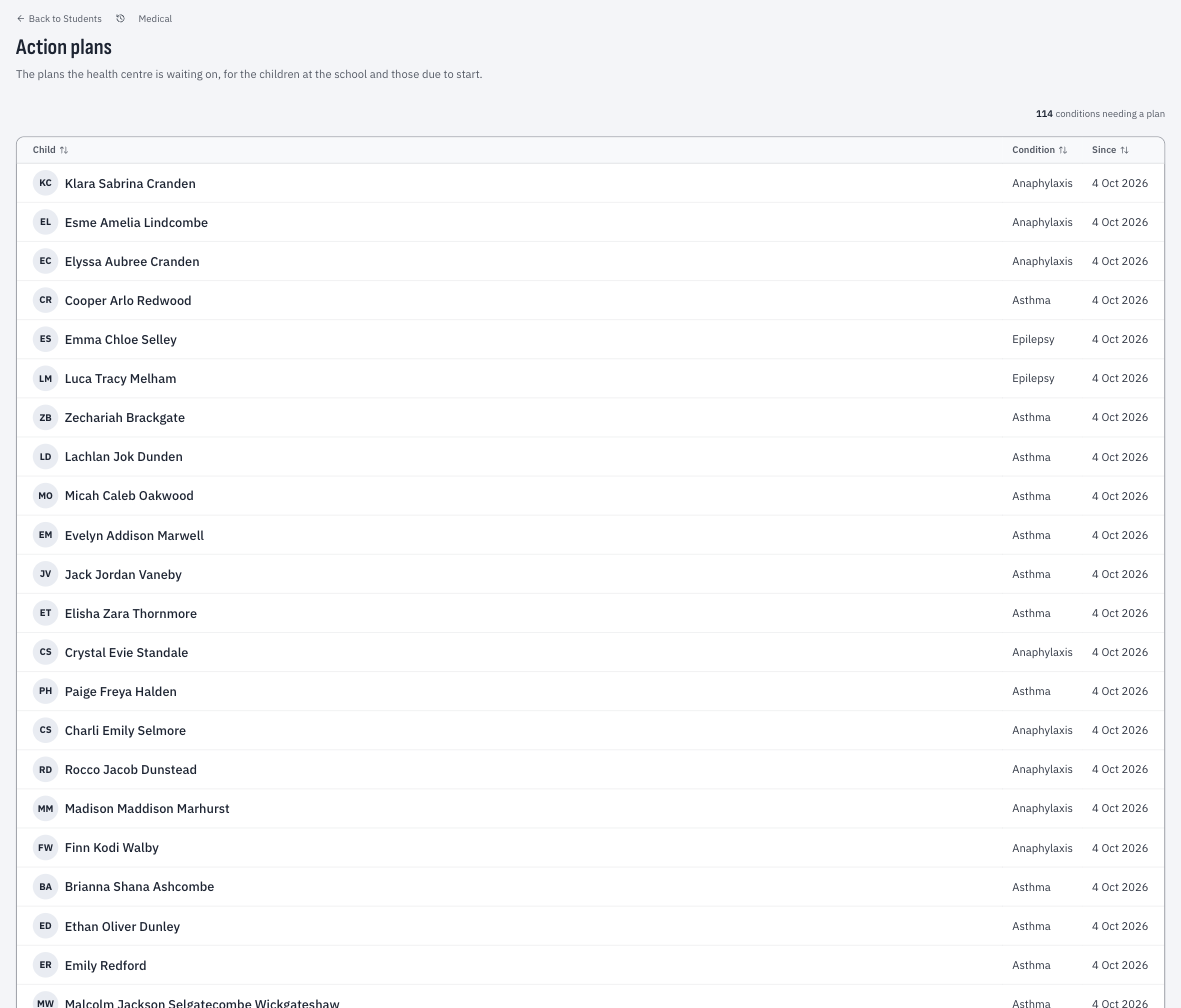
A health centre’s risk is rarely the record it holds. It is the anaphylaxis plan that expired in March, the dose no-one logged, and the child starting in three weeks whose plan has not arrived. Kestrel is built around those three.
At a glance
Kestrel’s medical module keeps conditions declared at enrolment, action plans checked against your state’s rules, a medication log, sick bay visits and immunisation status.
Declared once
What a family declares at enrolment is written on the child as a condition.
Plans against your state’s rules
Each plan reads current, due or overdue, against the warning window your school sets.
Each dose kept
Doses given and corrected under the parent’s signed authority, in a log that keeps each entry.
Sick bay and immunisation
A child sent home is already on the roll, and immunisation is kept as dated AIR statements.
Questions schools ask
Does Kestrel support Ministerial Order 706?
Yes. A Victorian school is asked for an anaphylaxis plan for each student at risk, and a plan reviewed more than a year after it was issued is refused, as the Order requires.
How are expiring action plans tracked?
Each plan reads as current, due for review soon or overdue against a warning window the school sets, and a weekly job asks the family for the next plan, once.
How is the medication log kept?
Each dose is given and corrected in a log that keeps each entry. A medication is changed from now or stopped, and its history stays with it.
Show the detailHide the detail
Declared once, at enrolment.
What a family declares on the application form is written on the child as a condition. No-one retypes it.
Action plans, and your state’s rules about them.
A nurse records an action plan over a condition, and each plan reads as current, due for review soon, or overdue, against a warning window the school sets. A teacher and a head of house can read the plan, so it is in reach during an incident.
The school sets the state it is in, and the rules follow. A Victorian school is asked for an anaphylaxis plan for each student at risk, and is refused a plan reviewed more than a year after it was issued. Ministerial Order 706 requires it. The compliance is built into the software, so no-one needs to remember a circular.
A medication log that keeps each entry.
Medications are dated rows with the parent’s signed authority, opened by an approved authority form. The nurse gives and corrects each dose in a log that keeps each entry. What you can do to a medication row is deliberately narrow:
That last rule is the whole design in one line. A medication administration log is evidence. If it can be made tidy afterwards, it is not.
Sick bay, and the roll.
The nurse records a visit from the Health section of the child’s record. Where a child is sent home, attendance already knows: the roll reads “Sent home by sick bay” with the time and no reason. The rest of that day stops being chased as unexplained, and the next day is read normally.
If a teacher marks that child present after they left, the office is shown the contradiction. The system does not silently prefer one of the two.
Immunisation, as dated statements.
A child’s immunisation status is a dated row per AIR statement. The enrolment form’s statement writes the first one; the registrar records a later statement, or takes one off the record as entered in error. The nurse and the registrar read the students placed today whose status is unknown or not up to date, by year level.
Three standard reports sit in the library: students with a condition by kind and year level, action plans by review date, and the immunisation status of a year level. Each runs as at today or as at a date you name, and downloads as CSV or PDF. So the figure in a board paper can be reproduced later.
What the night raises.
The health centre contributes to the overnight read, and each row of it sits at the restricted tier. Each finding names the condition, the plan or the medication, and leaves the child to the row it belongs to. That way, a list that crosses a desk does not read as a diagnosis beside a name.
Bring your hardest plan.
Start with the eight-minute film. Then, if you’d like, forty minutes with us on your state’s rules and your worst compliance memory.