The person record
One person, however many roles they hold.
A parent who is also a staff member and an old scholar is one record with three roles. Everything else on this site rests on that being true.
At a glance
Kestrel’s person record holds one record for each person, student, parent, staff member or alumnus, with the roles and family relationships they hold today.
One record, all roles
Student, parent, staff member or alumnus: one person, one record, with the roles they hold today.
The family as it is
Step-parents, carers and households, drawn as a list or a tree from great-grandparents to great-grandchildren.
Protected everywhere
A protected record changes what search, the statutory returns, consent and ring-around lists will answer.
Corrections and merges
Duplicates proposed on the record and merged by a registrar, with each open written once to the audit trail.
Questions schools ask
Can one person be both a parent and a staff member?
Yes. A parent who is also a staff member and an old scholar is one record with three roles.
How does Kestrel show blended and extended families?
The Family section reads as a list or as a tree, from great-grandparents to great-grandchildren, with step-parents, carers and households drawn.
What happens when a person has two records?
Kestrel proposes them as duplicates on the record itself, and a registrar merges them.
Show the detailHide the detail
Roles, not record types.
The console says students, staff, parents, alumni or residents in the place where other systems say “people”. The word a school uses tells you which question it is asking. Underneath, it is one record and a set of roles held over spans of time.
The family, as it is.
The Family section reads as a list or as a tree, a generation to a band, from great-grandparents to great-grandchildren.
Relationships are worked out, not filed.
The roles a person holds and the ties they have are derived when asked, from the relationships and spans recorded. None of it is stored as a second copy, so there is no state in which the summary disagrees with the record.
It is also tiered. The kind and the label of a relationship read at the sensitive tier, and a current student’s summary names no siblings or cousins. A class list that quietly discloses which children are related is a disclosure no-one chose to make.
A protected record is protected everywhere.
Protection changes what the rest of the record will answer.
Notice the pattern: the answer is the same answer everyone else who may not be contacted receives. A refusal that looks different is a disclosure, and a school only finds that out the hard way.
Corrections, and two records for one person.
A school searches its own record, opens one, and corrects the names, the numbers and the spans it holds. Where two records turn out to be the same person, Kestrel proposes them as duplicates on the record itself. A registrar merges them, and the merge can be reversed inside the window the school sets.
That reversal matters more than the merge. Merging is the easy half; all systems offer it. The reason schools avoid using it is that a wrong merge has historically been permanent.
One open, one line in the audit trail.
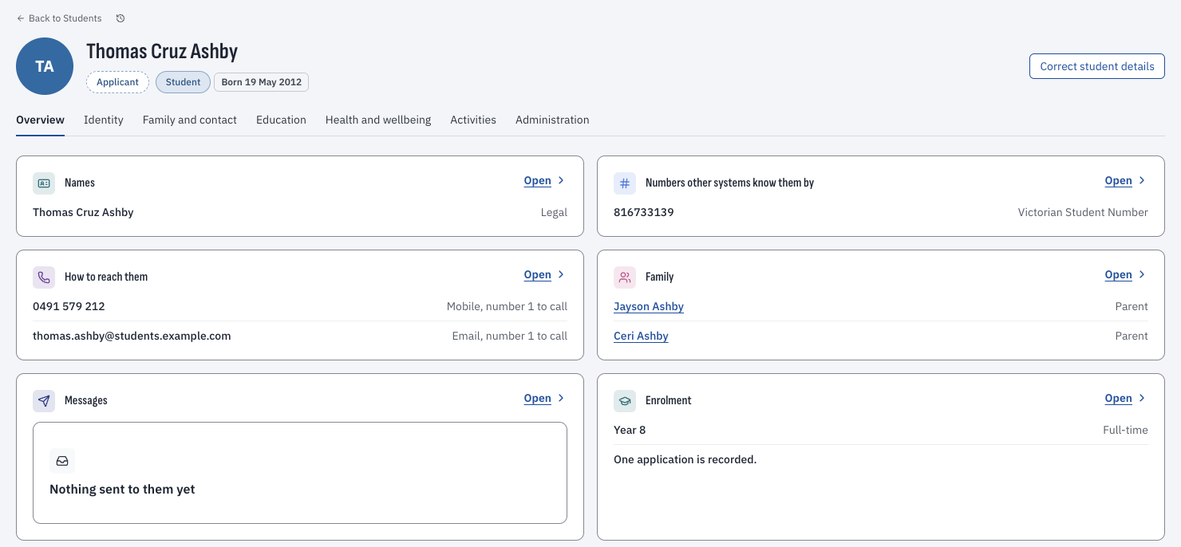
Opening a record reads the person and the identifier schemes together, and the cards on the overview reuse those answers. So one person opening one record writes one read to your audit trail.
An audit trail that logs three reads because a page made three requests is an audit trail no-one can use as evidence. The count no longer means anything.
Bring your most complicated family.
Start with the eight-minute film. Then, if you’d like, forty minutes with us on your most complicated family.