Kestrel School Systems Report 2026
School systems in 2026: what 460 independent schools run
The typical independent school runs about 12 systems from nine suppliers, and its parents use three separate tools.
Systems
11.5
run by the median school
Suppliers
9
behind those systems
Parents
36%
of schools give parents four or more tools
Suites
61%
of schools use both Microsoft and Google
Summary
For the Kestrel School Systems Report 2026, we looked at the public technology records of 460 independent schools in Australia and New Zealand, including all Australian independent schools with 750 or more students. We used only records anyone can look up: public DNS records, certificate transparency logs, the public login pages of school portals, and schools’ own websites, annual reports and job advertisements. We did not log in to any school system or access any private data.
- The median school runs 11.5 systems That is more than most schools would list.
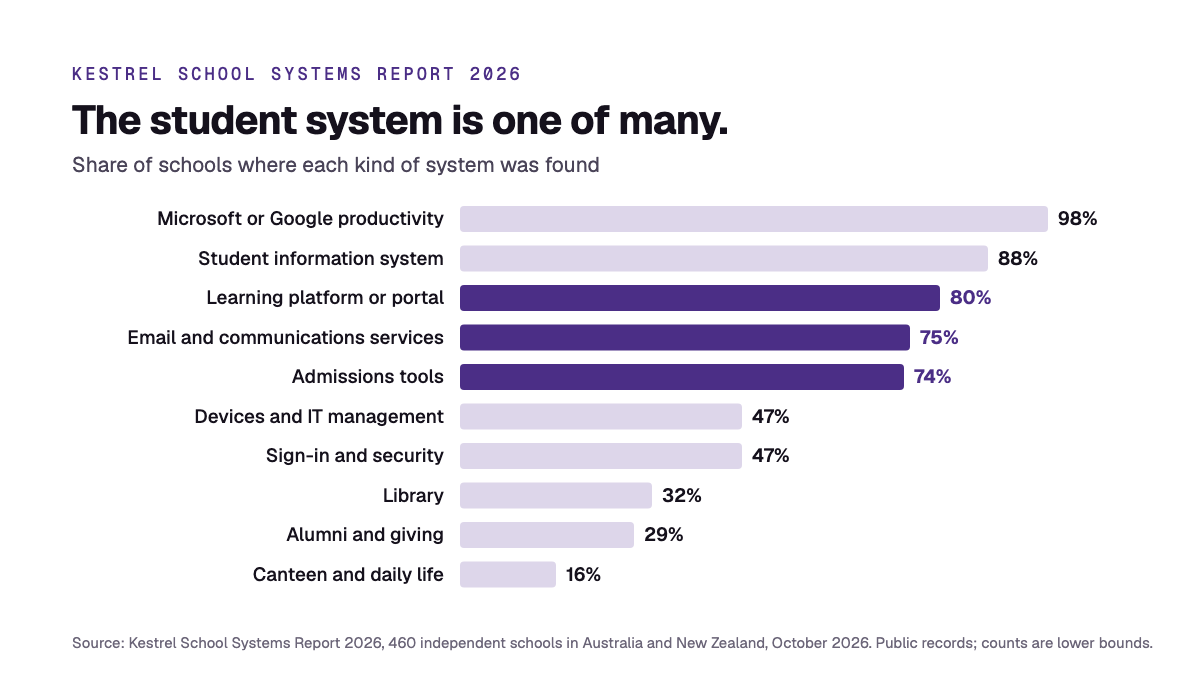
- The student system is one of many Four in five schools also run a learning platform or portal, and three in four run separate admissions tools.
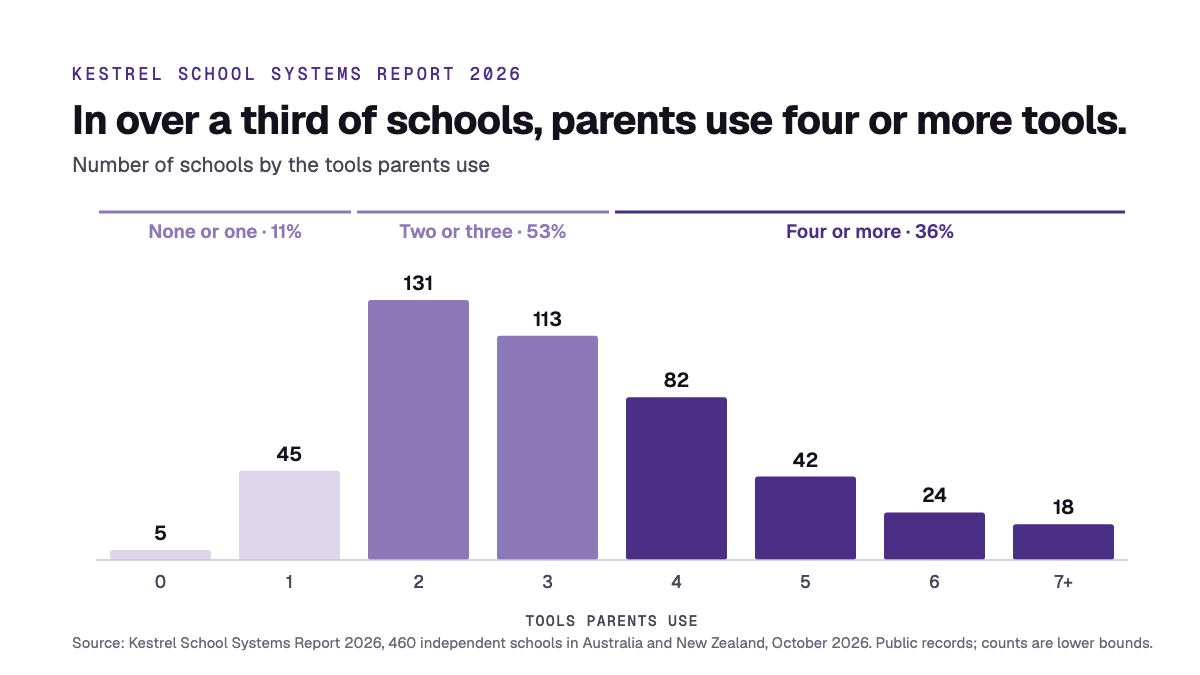
- Families feel the spread At more than a third of schools, parents use four or more separate tools.
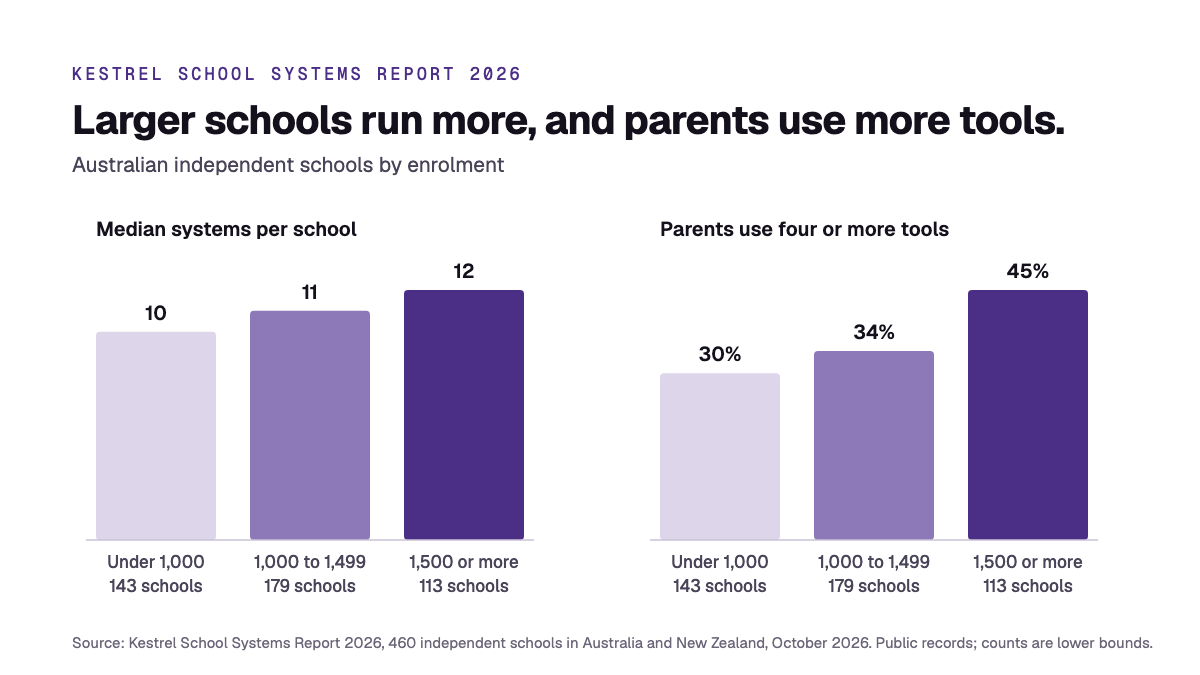
- The count rises with school size Larger schools run more systems, and their families use more tools.
- Each system adds a supplier Each one brings a contract and its own records.
Finding 1: The median school runs 11.5 systems
Seven in ten schools run between 8 and 15 systems. A tenth run 6 or fewer, and a tenth run 17 or more. Sixteen schools run 20 or more, and the highest count at one school is 28.
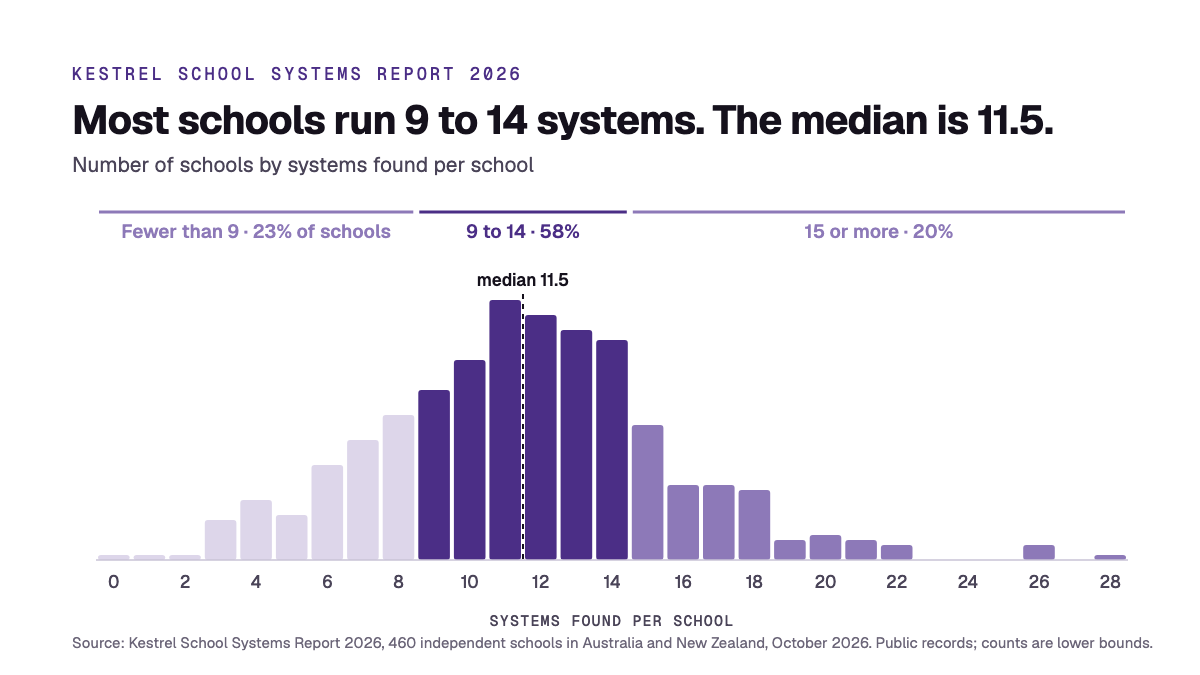
These counts will usually be higher than the answer a business manager gives when asked how many systems the school operates. Many are everyday tools set up at school level, such as device management, design software licences and video calls, which rarely appear on a school website. At the median school, 57% of the systems we found showed up only in technical records such as DNS and certificate logs. Across all schools, technical records and the school’s own material both named a further 15% of systems. A record shows that a service was set up for the school. Most point to a live service, but some may be left over from a trial or a retired system.
Finding 2: The student system is one of many
Beside the student system, 80% of schools run a learning platform or portal, 75% run email and communications services, and 74% run admissions tools. Almost all schools use Microsoft or Google for email and documents, and 61% use both.
Half the schools (51%) buy a dedicated admissions product. At those schools, a family’s details start life outside the student system and have to be moved across when the child enrols. Twenty-six schools run two student systems at once, usually across campuses or partway through a move.
Finding 3: Families feel the spread
Parents at the median school use three separate tools, and at 36% of schools they use four or more. Each tool has its own login, its own notices and its own place to update a family’s details, so those details end up held in several places.
Finding 4: The count rises with school size
The median rises from 10 systems at schools under 1,000 students to 11 at 1,000 to 1,499, and 12 at 1,500 or more. The share of schools where parents use four or more tools rises from 30% to 34% to 45%. A smaller school has fewer people to look after each system, so ten systems can be as much work for it as twelve are for a larger school.
Finding 5: Each system adds a supplier and its own records
IT teams call this application sprawl. Each system arrived for a good reason, and together they add suppliers, logins and copies of family details to manage. The median school manages nine suppliers.
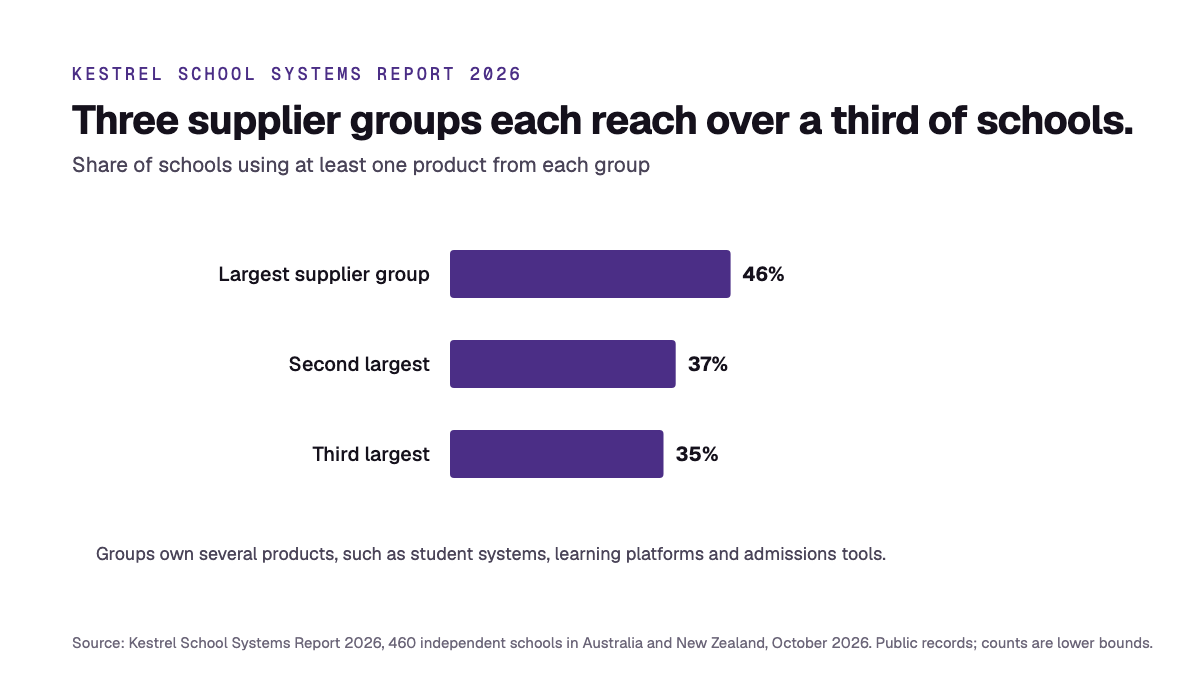
Three supplier groups each reach more than a third of schools, often through several products. A school can hold several contracts with what is now one company, and each product still keeps its own records and logins. About one school in ten (9%) runs its student or learning software on its own servers, which keeps upgrades, patching and backups in house. That rises from 4% of schools under 1,000 students to 11% of larger schools.
What this means for your school
The number of systems grows with the school, and each addition makes sense on its own. The cost shows up between the systems: family details kept in several places, enrolments moved by hand, and permissions to review in each product. The natural moment to act is a contract renewal or a forced move to a new version. That is when a school can ask whether a system still needs to stand alone, or whether its work belongs in one record of each person.
Retired systems often leave records behind. When a system or trial ends, removing its domain records and web addresses keeps the school’s setup easy to read and stops addresses pointing at accounts that no longer exist.
To see where your school sits, count the systems your people, students and families use, leaving out internal systems such as the finance ledger and payroll. Then find your count on the bands in the first chart, and your parents’ tools on the bands in the parents chart.
Six questions for your leadership team
- Which services do your people, students and families use, including ones a single department set up?
- Where does each family’s information live, and which copy is current when two disagree?
- When a student enrols or leaves, what does someone still update by hand?
- Who can see wellbeing and medical information, and who reviews that access?
- When does each contract renew?
- When a system is retired, who removes its web addresses and domain records?
About the research
We counted each product once per school, however many web addresses it uses, and found 5,298 systems in all.
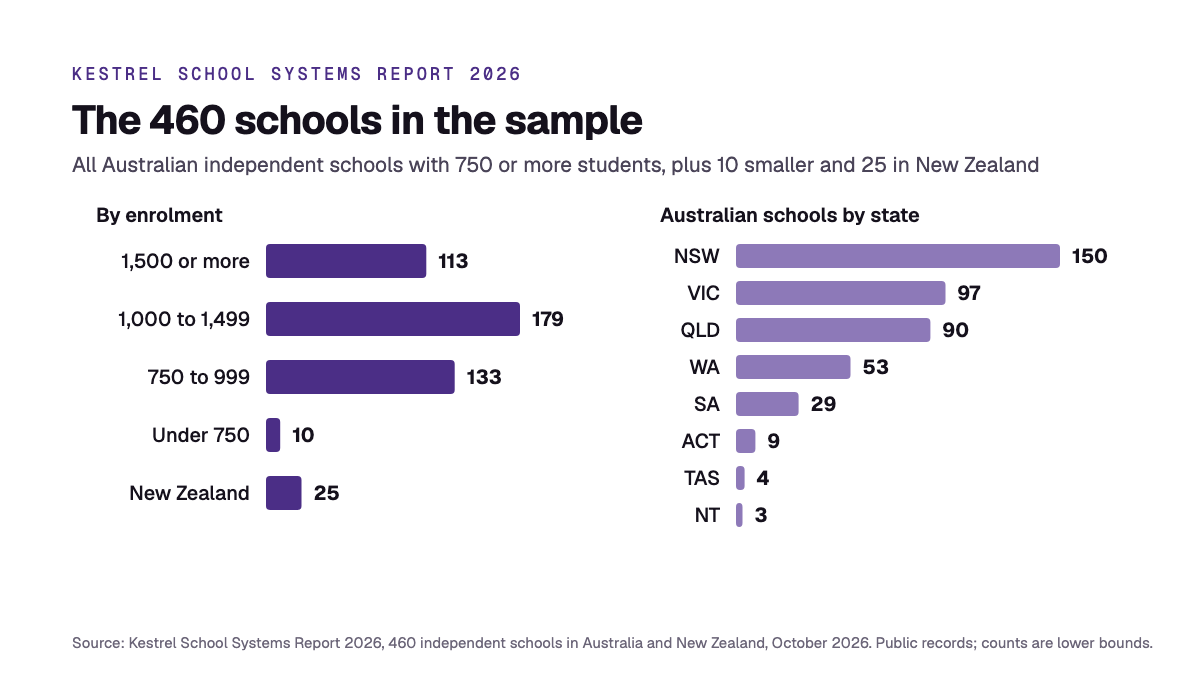
Public records show less than a school runs, so all counts are lower bounds. Systems with no public web address, such as the finance ledger, payroll and timetabling, mostly leave no trace. A record shows that a service exists. It cannot show how much the school uses it or how well it connects to other systems. Records can also lag: a retired system may leave records behind for a while, and a new one may not appear yet. Where a school’s own pages named a change, we followed the pages. A count of systems says nothing about how well a school runs them.
Kestrel is a student information system for Australian independent schools, built around one record for each person. Admissions, attendance, assessment, wellbeing, medical, co-curricular, portals and communications all use that record, and specialist systems such as the finance ledger connect to it. Hoverpoint, the company that makes Kestrel, researches and publishes the Kestrel School Systems Report.